Monday, December 14, 2015

4 Stages of the Cell Cycle

Explain the events of all stages of the cell cycle.
There are four parts of the cell cycle:
G₁- “first gap”: growth period, first part of interphase.
S - synthesis: DNA is copied, chromosomes duplicate
G₂ - “second gap”: growth period AFTER DNA has duplicated, second part of interphase
M - Mitosis and Cytokinesis: distribution of genetic material and cytoplasm to form two daughter cells. [See "Stages of Mitosis" under Ch 12 & 13 for more information on Mitosis]


A cell spends most of its life growing in interphase, and only a short amount of time in mitosis.

https://en.wikibooks.org/wiki/Cell_Biology/Cell_division/Mitosis

Monday, December 7, 2015

Chapter 11

Cellular Communication
Also, a little on Apoptosis and Cell Communication Regulation

Receptor Tyrosine Kinase


Friday, November 20, 2015

ATP Production in Cellular Respiration


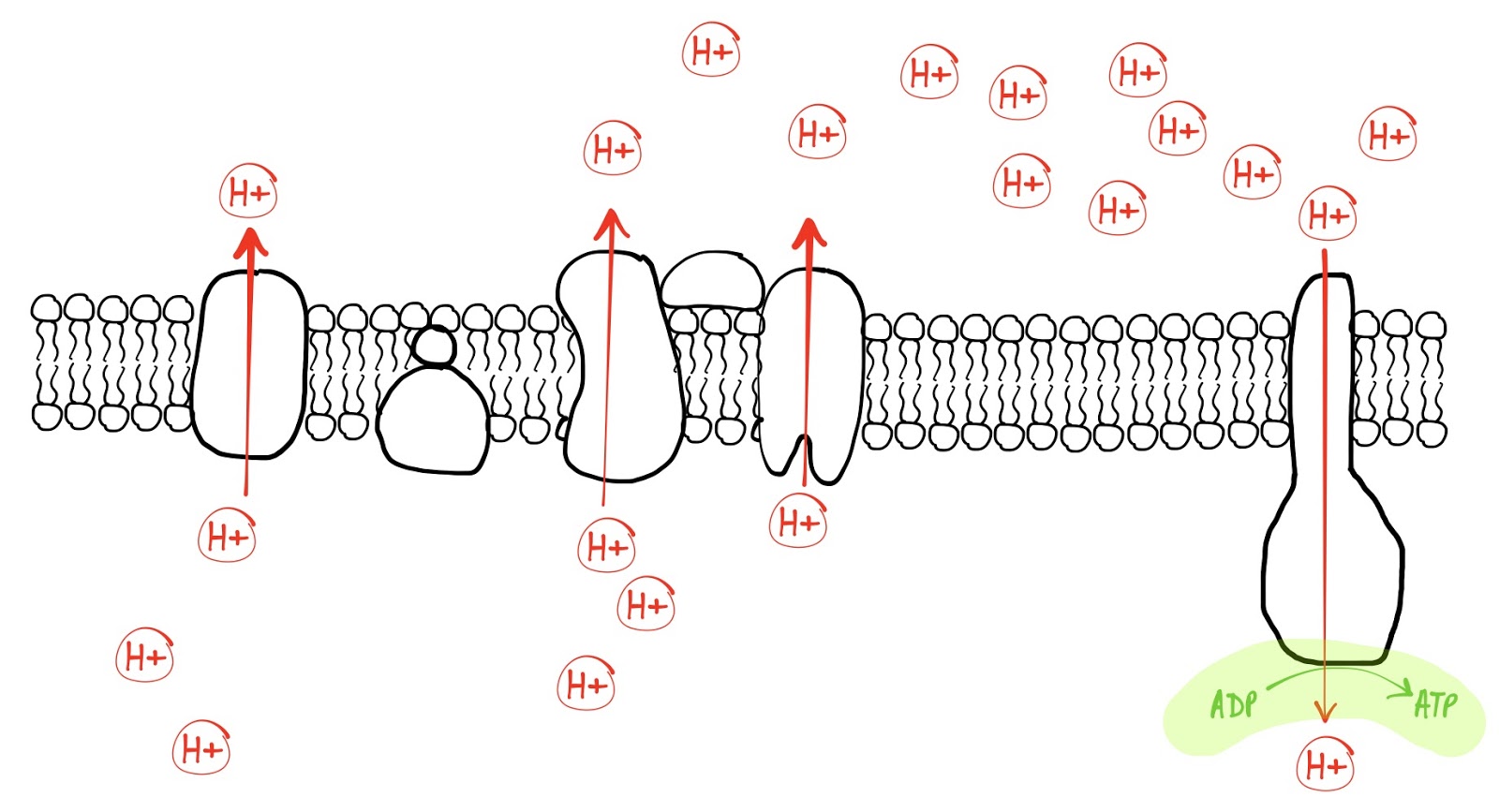
Create a visual representation to describe the structure of cell membranes and how membrane structure leads to the establishment of electrochemical gradients and the formation of ATP.

Take a look at this simplified drawing of the Electron Transport Chain, and how it creates ATP through the movement of H+ ions across the membrane.

Photosynthetic Animals

Pose scientific questions about what mechanisms and structural features allow organisms to capture, store, and use free energy (e.g., autotrophs versus heterotrophs, photosynthesis, chemosynthesis, anaerobic versus aerobic respiration).

Is it possible for animals to photosynthesize? Why or why not?

A Look At Photosynthesis

Refine or revise a visual representation to more accurately depict the light-dependent and light-independent (i.e., Calvin cycle) reactions of photosynthesis and the dependency of the processes in the capture and storage of free energy.
Light-dependent reactions occur in Photosystem II, and light-independent reactions occur in Photosystem I. The two pictures below show the interactions between the two.

Mastering Biology | Pearson; Campbell Biology

Fish are Cooler Than Humans

Describing 2–3 different strategies that organisms employ to obtain free energy for cell processes (e.g., different metabolic rates, physiological changes, variations in reproductive and offspring-rearing strategies).

  1. Regulation of body temperature: Tuna fish are able to regulate their internal body temperature better than some other sea life. This allows them to swim in a varying range of temperatures. This mobility gives them access to a greater amount of resources.
    http://www.fao.org/fishery/topic/16082/en
  2. Consumption of other organisms: We humans obtain practically ALL of our energy through eating plants and other animals. Because we are unable to photosynthesize, or hunt stealthily for our food, we have had to improvise and become a species that farms and raises animals for food.
    http://veganfeministnetwork.com/tag/food/

Mustard Plants

Propose experimental designs by which the rate of photosynthesis and respiration can be measured and studied.
Plants go through both photosynthesis and cellular respiration, so they would be perfect subjects to use in an experiment that measures the rate of the two processes. Mustard plants [these plants are easy to grow, and grow quite rapidly] can be grown under lights with different colored filter, and their growth will be monitored to see how photosynthesis is impacted by different colored waves of light. To study the rate of respiration, a separate set of mustard plants can be grown in containers that vary in the amount of oxygen they allow in for the plant to use. Light is required for photosynthesis, and oxygen is required for respiration, so these are the two independent variables that will be changed, and the dependent variable, growth of plant, will provide rates of photosynthesis and respiration.
http://www.vegetablegardener.com/item/3477/how-to-grow-mustard/page/all

The Canadia Goose

Explain how energetic requirements contribute to the adaptations of organisms.  Provide examples to support your statements.
Over time, organisms evolve according to the amount of energy available for their consumption in the environment they habitat. Birds, for example, migrate during colder seasons to warmer areas where their food is more readily available. If Canadian geese were to stay up north during winter, they would die from the extreme cold temperatures before they would starve. Even if they were able to survive the winter cold, they still would starve as there is no vegetation available to feed on.
http://www.walkingmountains.org/2015/03/reintroduction-of-the-canada-goose/

Siblings, Not Twins.

Explain the relationship between photosynthesis and cellular respiration at the molecular, organismal, and ecosystem levels of organization.
Photosynthesis and cellular respiration are very similar because they are essentially the reverse process of one another. Photosynthesis uses energy to create sugar, and cellular respiration breaks down sugar to create energy.
Photosynthesis: 6CO₂ + 6H₂O → C₆H₁₂O₆+ 6O₂
Cellular Respiration: C₆H₁₂O₆+ 6O₂ → 6CO₂ + 6H₂O + energy
So on the molecular level, these two are palindromes of each other.
The only organisms that have photosynthesis are plants, other organisms only have cellular respiration. So in an ecosystem, trees and other plants would use photosynthesis to create food for themselves. In the process, they would expel oxygen, which powers the animal kingdom’s ability to breath and ability to go through cellular respiration.

Chemiosmosis

Describe the process of chemiosmosis and compare its function in photosynthetic and respiratory pathways.

Chemiosmosis is the movement of ions across a membrane, following the concentration gradient. In photosynthetic and respiratory pathways, H+ ions are pumped through the electron transport chain to create ATP. In respiratory pathways, ATP is produced almost at every step of the process, with the most being produced at the ETC. In photosynthetic pathways, ATP is mainly formed in photosystem II where the ETC in the thylakoid membrane produces ATP.

Photosynthesis: Prime Sightseeing Locations

Match all photosynthetic processes to their location in a typical eukaryotic, autotrophic cell.
Light-dependent reactions - thylakoids within chloroplasts
Calvin Cycle - stroma of chloroplasts

Tracking Energy & Matter in Photosynthesis

Trace the movement of energy and matter through all photosynthetic processes.
Energy enters as light in the chloroplast, where it is utilized to create ATP and NADPH [in light-dependent reactions] which will aid in the formation of sugar in the calvin cycle. It then is cycled back into light-dependent reactions as ADP and NADP+ where it is formed back into ATP and NADPH with light energy.
Water is the first substance to enter the photosynthetic process, but it leaves as oxygen. Carbon dioxide enters next, and exits as sugar. These two processes occur simultaneously, the first in thylakoids, and the second in the stroma of the chloroplast in the calvin cycle.

Light Reactions and Calvin Klein Cycle

Explain the inputs, major processes, and outputs of the light reactions and the Calvin Cycle.
Light Reactions
Input: H₂O, Light
Output: O₂, ATP, NADPH
Here, Light energy and water is utilized to create ATP and NADPH which will go into the Calvin Cycle and power it to create sugar the plant can use as food.
Calvin Cycle
Input: CO₂, ATP, NADPH
Output: Glyceraldehyde 3-phosphate [G3P]
This is an anabolic action that uses ATP’s energy and NADPH’s reducing power [gain of electrons, storage of energy] to build sugar. Carbon dioxide enters the cycle and is fixated by the enzyme rubisco, then reduction occurs as the carbon dioxide becomes sugar. But, this must occur three times for one G3P to be formed. So, once carbon dioxide is fixated and reduced,the CO₂ acceptor RuBP is regenerated so that the next carbon dioxide entering the cycle can be fixated. Once this process occurs thrice, a sugar [G3P] is created.

https://biologycieri.wikispaces.com/Week+15  AND   http://www.adweek.com/adfreak/gif-shows-you-just-how-photoshopped-justin-biebers-calvin-klein-ads-were-162280  →but there is really no need for you to visit this site.

p.s. It's not called the 'Calvin Klein Cycle'. It's just Calvin.


Cellular Respiration: Prime Sightseeing Locations

Match all cellular respiratory processes to their locations in a typical eukaryotic cell.
Glycolysis - cytosol outside of mitochondria
Pyruvate Oxidation - occurs during the movement of pyruvate from cytosol to matrix. Pyruvate is oxidized to Acteyl CoA.
Citric Acid Cycle - matrix of the mitochondria
Oxidative Phosphorylation & Electron Transport Chain - cristae of mitochondria
https://www.studyblue.com/notes/note/n/bisc-103-midterm-i/deck/1084064

Wednesday, November 18, 2015

Tracking Energy & Matter in Cellular Respiration

Trace the movement of energy and matter through all cellular respiratory processes.
Energy enters as Glucose and through glycolysis it is broken down to create ATP, pyruvate, and NADH. NADH now carries energy to the electron transport chain where the most ATP is created with the help of the proton-motive force. The PTM ‘powers’ the ETC as it uses the electrochemical gradient and ratio of protons & electrons provided by electron carriers [such as NADH] to push the actions of the ETC to create ATP. 
So based off of the movement of energy, matter moves through the mitochondria starting outside the organelle in the cytosol. The products of glycolysis move into the mitochondria where they undergo further break down and oxidation of energy, finally moving to the ETC in the cristae of the mitochondria. Here, the most ATP is created and this energy material is used to power the cell.

Glycolysis, Fermentation, Death and Aerobic Cellular Respiration

Explain the inputs, major processes, and outputs of glycolysis, fermentation, and aerobic cellular respiration.
Glycolysis
Input: Glucose, ADP, NAD+
Output: Pyruvate, ATP, NADH
After a glucose molecule enters the cell, it is broken down in the cytoplasm. It is oxidized [loss of electrons, loss of energy] to 2 pyruvate, 2 ATP, and 2 NADH. NADH carries electrons to the electron transport chain, where most the most ATP is made in cellular respiration. The pyruvate enters the mitochondria and enters the citric acid cycle after it is oxidized into Acetyl CoA.
Fermentation
Input: Glucose, ADP
Output: Lactate OR Alcohol and CO₂, ATP
Fermentation occurs when there is no oxygen available for cellular respiration. Oxygen helps create the most ATP, but ATP still needs to be made even if oxygen is not available. ATP keeps organisms running. Because fermentation does not create as much ATP, I guess this may explain why oxygen-breathing organisms die when their supply of air is cut off. Fermentation uses phosphorylation to enzymatically create ATP. This results in the production of lactate [animals produce this] OR alcohol and CO₂ [bacteria produce this] which is harmful for organisms as the buildup can cause fatigue.
Aerobic Cellular Respiration
Input: Oxygen, Glucose, ADP, NAD+
Output: ATP
Aerobic respiration is complete cellular respiration, with glycolysis being the first step. Once 1 molecule of glucose has been broken down to 2 ATP, 2 NADH [this goes directly to the electron transport chain (ETC)], and 2 pyruvate, the pyruvate is oxidized [loss of electrons, loss of energy] and turns into Acetyl CoA. This enters the citric acid cycle, where every turn produces 2 CO₂, 3 NADH, 1 FADH, and 1 ATP. This gives us a total of 4 CO₂, 6 NADH, 2 FADH, and 2 ATP. The FADH and NADH, which contain the energy of the process, move to the ETC. Here, at the ETC, FADH and NADH are utilized to create the most ATP, about 30-32 to be exact.

Monday, October 26, 2015

Experimental Design

Propose experimental designs by which the rate of enzyme function can be measured and studied.

The rate of enzyme function can be measured and studied by having an enzyme catalyze reactions in different temperatures, in different pH, in different concentrations of substrates, etc. to see how the enzyme functions if one variable is changed slightly. These are all variable that impact an enzyme’s productivity, so picking any one of these variables ]or some other variable that impacts enzyme functioning] and modifying it slightly as you measure the change in productivity can help study the rate at which an enzyme functions. Depending on the enzyme and variable used/ manipulated, different equipment will be needed for the experiment. If I were measuring the rate of enzymatic activity in different pH, I would need to add acid or base to an enzyme in it’s natural environment, then measure the change in time, or change in production of the product.

Sunday, October 25, 2015

Demented PAC-MAN and Competitive Interactions

Describe how enzyme-mediated reactions can be controlled through competitive and noncompetitive interactions.
The following is a helpful little video that explains competitive and noncompetitive interactions through animation:

Enzymes are Serial Huggers

Describe the relationship between the structure and function of enzymes.

Substrates are reactants that attach to enzymes, and detach as a product of the reactants. The structure of an enzyme dictates what reactants it can help catalyze. When reactants enter and bond with an enzyme, the enzyme will reshape itself slightly around the substrate, to create a more snug hold. This allows the reactants to be in very close proximity, forcing the reaction to run faster.

Traffic Jam on Metabolic Lane

Explain how enzymes accomplish biological catalysis.  Provide examples.
Enzymes are reusable catalysts that speed up metabolic reactions. Without enzymes, metabolic reactions would take so long that an organism would not receive the needed substances fast enough. There would be a build up of reactions waiting to occur because the amount of time and energy needed to reach the activation point wouldn't be available. Imagine having to wait hours for painkillers to kick in when you have a raging headache. Sounds fun! Enzymes speed up chemical reactions by lowering the activation energy needed for products to form. This allows molecules involved in the reaction to absorb more energy in lower temperatures, causing the reaction to again enough energy to form products more quickly. Take a look at the figure below: it shows how substrates and enzymes work to lower the activation energy.
Mastering Biology | Pearson; Campbell Biology

Enzyme Environmental Conditions

Analyze data showing how changes in enzyme structure, substrate concentration, and environmental conditions (pH, temperature, salinity, etc.) affect enzymatic activity - ie. include a graph of each example and predict the effects when one of the parameters is further changed.
Justify and explain your predictions.
Enzymes have ideal states of pH and temperature in which they have optimal enzymatic activity. If an enzyme is placed in an environment in which the pH or temperature is not ideal, the rate at which it functions will be altered. Take a look at the graphs below. If a typical human enzyme was placed in a thermophilic bacteria, the human enzyme would be inactive and possible become denatured. Why? Because the optimal temperature for the enzyme to activate is around 37 degrees, anything past 50 degrees is too high and the enzyme can become damaged because it is not in an environment in which it can survive. Same goes for pH with pepsin and trypsin. They cannot exchange locations and be expected to function because they are only stable and functioning in their own environment.
enzymes changing.PNG
Mastering Biology | Pearson; Campbell Biology

Energy Coupling Reactions


Explain the key role of ATP in energy coupling reactions. Provide a model showing energy before and after phosphorylation of the reactants.

Energy coupling is the process of using the energy released from exergonic reactions to drive endergonic reactions. ATP is not only a cell’s main source of power, but also responsible for energy coupling reactions. Energy is stored in the bond between the third and second phosphate in ATP, and when this bond is broken by hydrolysis [catabolic reaction], energy is released. This energy could be used to facilitate all sorts of cellular work, such as stimulate a potassium-pump to run[anabolic reaction].


Exergonic and Endergonic Reactions

Compare and contrast Exergonic and Endergonic reactions - include a model of each showing the change in free energy from reactants and products.
Exergonic - Catabolic reactions. They break down substances and require no energy, so they are able to occur spontaneously. The change in free energy in these reactions are negative because the reactions break DOWN to create products.

Endergonic - Anabolic reactions. They build up substances and require energy to do so. As a result, these reactions can only occur when energy is available. The change in free energy in these reactions are positive because reactants work UP to create a product.


Monday, October 19, 2015

Lil' Plant Cell

Create a visual representation/model (ie. graph or diagram) to make predictions about the exchange of molecules between an organism and its environment, the use of these molecules (ie. CHNOPS and incorporation into carbohydrates, proteins, lipids, nucleic acids, membrane structure, genetic information, etc.), and consequences to the organism if these molecules cannot be obtained.
Take a plant cell and put it in an isotonic solution. Take an animal cell and put it in the same isotonic solution. Which one is happier? The animal cell! [Take a look at ‘-tonic’ under Ch 7 yo understand why] With this in mind, understand that the plant cell is somewhat soft and limp because it is not in the ideal state of absorbing water and water soluble molecules, such as carbohydrates. The plant cell is not retaining the full amount of molecules it needs to be efficient at providing energy and structure to the whole plant. If this continues, and the solution changes to become a hypertonic solution, there will be no water retained in the plant cell, and it will become very limp and quite squishy. As a result, it will have a hard time creating energy and providing structure to the plant. If all plant cells end up like this within a plant, the plant may rot and die from lack of water.

Sunday, October 18, 2015

Endo- and Exo- -cytosis

Describe the processes of endocytosis and exocytosis. Propose a model illustrating each process.
Endocytosis is the process of a cell taking in macromolecules by forming a vesicle around the substance with its own cell membrane. Exocytosis is the expulsion of material as a vesicle within a cell travels outwards and fuses with the membrane, opening up and ejecting the substances it was carrying.
http://ibbiology.wikifoundry.com/page/Explain+how+vesicles+transport+materials+within+a+cell

Active Transport

Describe active transport. Propose a model illustrating this process.
Active transport is the opposite of passive transport, in the way that active uses ATP to transfer material through a membrane whereas passive does not. This is the movement against the concentration gradient. Because substances are moving against the grain, they need extra help, an extra push. Proteins studded throughout the membrane facilitate this process. This is an important process because it helps cells work towards equilibrium, even when the surrounding environment is not the proper tonicity for a cell to maintain equilibrium. Please see ‘Glucose and Na+/K+ Transport’ under Ch 7 for an explanation of the sodium-potassium pump which is depicted below.
http://www.mhhe.com/biosci/esp/2001_gbio/folder_structure/ce/m3/s5/

Glucose and Na+/K+ Transport

Explain how membrane proteins play a role in facilitated diffusion of charged and polar molecules in general and in relation to the specific molecules below.
Glucose transport: These transport proteins are integral membrane proteins that allow glucose to pass through the hydrophobic [glucose is a hydrophilic polar molecule] regions of a cell membrane by creating a polar pathway for the molecule to pass through.
Na+/K+ transport: The sodium-potassium pump is activated by ATP and pumps two K+ ions into the cell as three Na+ ions leave the cell. The following link will take you to a very helpful and informative animation that is followed up with a mini quiz.
http://highered.mheducation.com/sites/0072495855/student_view0/chapter2/animation__how_the_sodium_potassium_pump_works.html

Passive Transport

Describe passive transport and explain its role in cellular systems
Passive transport is the movement of substances across a membrane without the expenditure of energy. Diffusion, facilitated diffusion, filtration, and osmosis are examples of passive transport. In cellular systems this is a very important action, because all ATP created by a cell is very precious, the more it can reserve and use for other purposes, the better. Essential substances such as lipids, water, oxygen, and small monosaccharides can pass through via passive transport and give the cell the materials it needs, without causing it to work overtime for it. Water, for example, is a very important substance in all cells. [See ‘-tonic’ under Ch 7 for more details on the importance of water in cells] Because water can diffuse in and out of cells passively, a cell is able to maintain its internal environment without exerting too much energy.

-tonic

Explain the terms: hypotonic, hypertonic or isotonic in relationship to the internal environments of cells. Illustrate each environment with a model and explain which environment is best for plant and animal cells. Justify and explain your model with evidence.
Hypotonic - Cells expand in this environment, because there is less solute outside the cell than there is inside. In an attempt to reach equilibrium, the fluid outside the cell will enter the cell to even out the solute-to-volume ration. This causes cells to swell because there is more fluid within the cell than there usually would be, there is more volume. This can cause animal cells to burst, [lysed] as they do not have cell walls to provide a hard casing. Plant cells love hypotonic solutions because they are able to fill up their vacuoles and internal environments with water and other substances. This gives plants structure and rigidity [turgid].
Hypertonic Solution - Cells shrivel up in this environment, because there is more solute outside the cell than there is inside. In an attempt to reach equilibrium, the fluid within the cell will exit and flow outside, to even out the solute-to-solution ratio. This causes cells the shrivel up because there the fluid that once gave the cell structure is now gone. In animal cells, this is called a shriveled cell. In plant cells, this is called a plasmolyzed cell.
Isotonic - Cells are at a normal state, the amount of solute outside and inside the cell is even. Animal cells and plant cells are both gaining and losing water in this state. This is the ideal state for animal cells; a constant exchange with the environment. But, this is not the ideal state for plant cells. Plant cells do not want to have a constant exchange of water, they want to retain water. If they are unable to retain water, plants will be limp.
Mastering Biology | Pearson; Campbell Biology

Tuesday, October 13, 2015

Chloroplasts and Mitochondria

Explain the structure and function relationships between chloroplasts and mitochondria
Chloroplast converts sunlight into energy, and mitochondria break this energy into cell-friendly ‘food’. Chloroplasts are harvesters, mitochondria are utilizers.

Relate structural and functional evidence in chloroplasts and mitochondria to the endosymbiotic theory of their origins.
Structural Evidence: Both have their own DNA, and have a double membrane
Functional Evidence: They can move on their own without instruction from the nucleus, and also divide on their own without instruction.
Conclusion: These organelles were once prokaryotic cells that were engulfed by a eukaryote. The eukaryote decided to utilise their functions to help itself and let them be.

To learn more about these two topics, watch this video that has an strange robotic-male voice over. Truly though, this is a very informational video.


Teamwork

Explain how several internal membrane-bound organelles and other structural features (e.g., ER, ribosomes) work together to provide a specific function for the cell (e.g., synthesis of protein for export) and contribute to efficiency (e.g., increasing surface area for reactions, localization of processes).
The endomembrane system consists of the movement of material between the membranous vesicles of a cell. [Nuclear envelope, smooth and rough ER, Golgi, lysosomes, vesicles, and vacuoles]Here, the rough ER and its ribosomes work together to synthesize proteins. The information to create these proteins comes from the nucleus via the nuclear envelope. The rough ER sends these proteins to the golgi, where they are packaged and sent to various locations within the cell to be digested [lysosome], stored [vacuoles], or function within the cell membrane.
https://en.wikipedia.org/wiki/Endomembrane_system


Basic Structure and Functions of Key Organelles

Describe the basic structure and functions of key cell organelles (nucleus, Golgi, ER, mitochondria, chloroplast, vacuoles, plasma membrane).

Nucleus - Houses the genetic information [DNA] of the cell. This is a circular structure usually located in the center of a cell, it is made of chromatin [tightly wound up DNA]

Golgi Apparatus - Modifies, stores, and reroutes materials sent over from the ER. This is a sort of wavy structure (which is located near the ER and nucleus) that is made of membranous sacs stacked up on top of eachother.

Endoplasmic Reticulum - Two kinds:
Smooth ER - Synthesizes lipids, metabolizes carbs, detoxifies drugs/poisons, and stores calcium ions [in Lumen]. It is more tubular than the rough ER and located throughout the cytoplasm.
Rough ER - Folds [in Lumen], assesses the quality of [also in lumen], and packages/reroutes proteins. This is a convoluted flat sac that is continuous with the nuclear membrane. Most of these are located around the nucleus as a result.

http://www.buzzle.com/articles/smooth-endoplasmic-reticulum-function.html
Mitochondria - Generates ATP and is the main power provider of a cell. This organelle has a double membrane, the inner membrane has many folds called cristae which function to produce ATP.Fun Fact: Mitochondria can trigger cell death by releasing certain enzymes.

Chloroplast - Double membraned plastid cell; this organelle is only found in plant cells and is the site of photosynthesis. It converts light energy into ATP. These organelles are green in color because of the green chlorophyll they contain, and have stacks of thylakoids that capture sunlight and convert it into usable power.

http://www.nature.com/scitable/topicpage/plant-cells-chloroplasts-and-cell-walls-14053956

Vacuoles - These organelles are mostly storage units. They store wastes [and also dispose of wastes], excess material, proteins, pigment, and also defensive compounds. They are usually bubble-like structurally and larger in plant cells than in animal cells, to provide structure and rigidity.

Plasma Membrane - A semipermeable membrane that functions as a barrier between the inside and outside of a cell. This regulates what enters and exits the cell.

Monday, October 12, 2015

SA:V Again!

Represent graphically and explain the relationship between surface area to volume ratios as it relates to the efficiency of cellular work.
Please see ‘SA:V and its Impact’ under 2.A.3 for more details on surface area to volume ratios.
This lab information may further explain the relationship between surface area to volume ratios.
"Why don't Cells Grow Indefinitely?" Lab
[from left to right] cell with length of 4, 2, or 1 unit(s) filled with sand to measure the mass of this cell, AND to calculate the surface area